ACCREDITATION
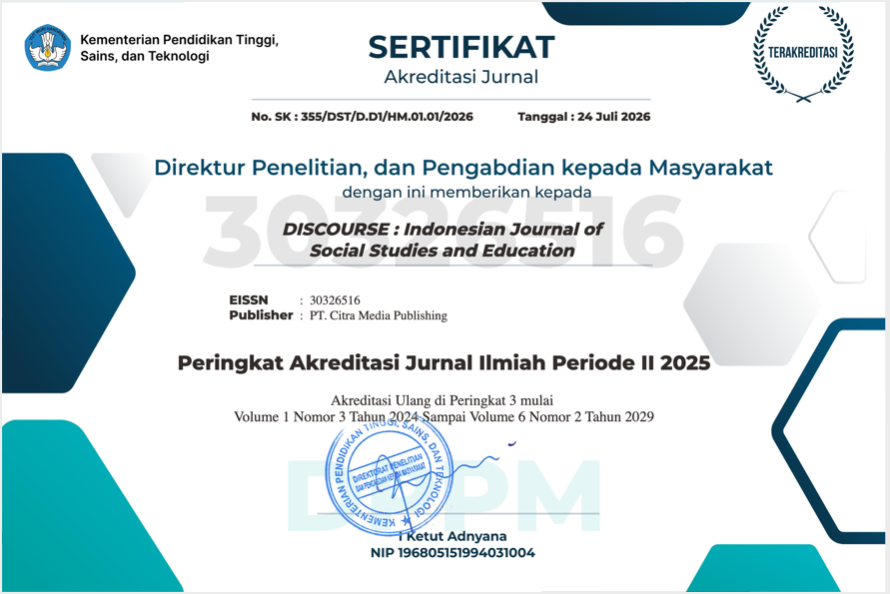
CERTIFICATE

The publication of articles in DISCOURSE: Indonesian Journal of Social Studies and Education is based solely on the academic quality, scientific rigor, and coherence of the submitted manuscripts, as assessed by the editors and peer reviewers. The review process is designed to ensure that all published articles make a meaningful contribution to the fields of social studies and education, both empirically and theoretically. DISCOURSE acknowledges and highly appreciates the scholarly contributions, critical insights, and constructive suggestions provided by its reviewers throughout the review process.
All manuscripts submitted to DISCOURSE undergo an initial editorial screening conducted by the Editor-in-Chief or assigned editors. This initial evaluation is typically completed within two weeks of submission. At this stage, manuscripts are assessed for their relevance to the journal’s aims and scope, originality, basic methodological soundness, and overall academic quality.
Manuscripts may be rejected at this stage if they are deemed to be outside the scope of the journal, lack sufficient originality, contain fundamental conceptual or methodological weaknesses, or fail to meet minimum academic standards. Manuscripts that pass the initial screening are forwarded to expert reviewers for further evaluation. The peer review process generally takes up to four weeks.
DISCOURSE applies a double-blind peer review process, in which the identities of both authors and reviewers are concealed. Each manuscript is typically reviewed by two to three independent experts in relevant fields of social sciences and education. Reviewers are asked to assess the manuscript’s academic merit, clarity, originality, and contribution to scholarly discourse, as well as to ensure that it does not substantially overlap with previously published work.
Reviewers are requested to evaluate manuscripts based on the following criteria:
The originality and clarity of the research objectives and the articulation of the research gap
The appropriateness and rigor of the research methodology
Adherence to ethical standards in research and publication
The clarity, coherence, and validity of the results or findings
The extent to which the conclusions are supported by the findings
The accuracy and relevance of references to prior scholarly work
Reviewers are not expected to perform language editing or copyediting. Language quality and formatting issues are addressed during the copyediting stage after a manuscript has been accepted.
Based on the reviewers’ reports, the Editor makes the final decision regarding acceptance, revision, or rejection of the manuscript. Where necessary, the Editor may consult members of the Editorial Board to reach a decision. The editorial decision is final, and authors are informed of the outcome along with anonymized reviewer comments.
Scholars who are not currently reviewers for DISCOURSE: Indonesian Journal of Social Studies and Education and wish to contribute as peer reviewers are invited to contact the editorial office. Serving as a reviewer offers opportunities to engage with current research, contribute to the advancement of scholarship in social studies and education, and receive formal acknowledgment from the journal. Reviewers for DISCOURSE serve on a voluntary basis, and no financial compensation is provided.
Interested scholars are requested to send a brief academic profile, areas of expertise, and institutional affiliation to the journal’s official email address. The editorial team will review all applications and may contact prospective reviewers accordingly.
ACCREDITATION
CERTIFICATE

DISCOURSE: Indonesian Journal of Social Studies And Education is licensed under a Creative Commons Attribution-ShareAlike 4.0 International License.
Published by Citra Media Publishing Collaboration With ASOSIASI PENELITI DAN PENGAJAR ILMU SOSIAL INDONESIA (APPISI)