ACCREDITATION
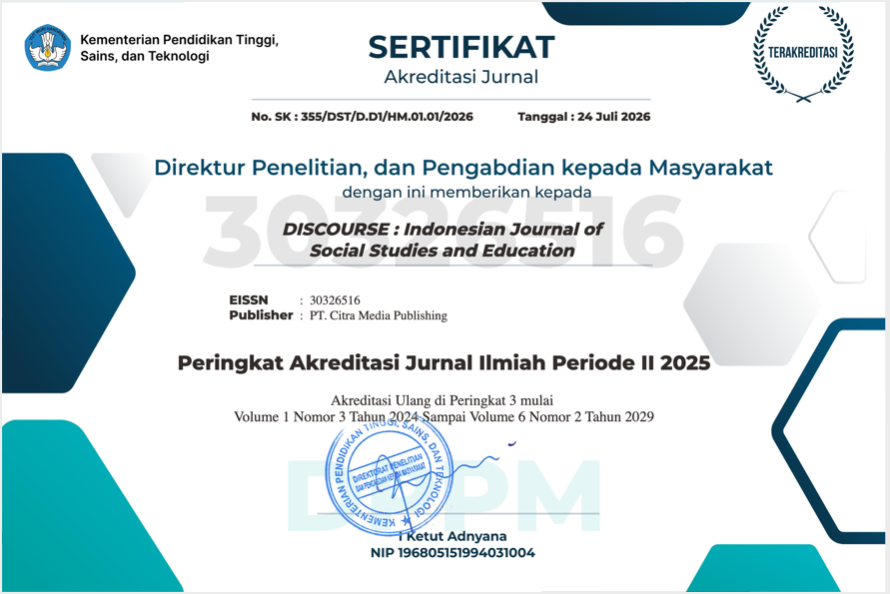
CERTIFICATE

DISCOURSE: Indonesian Journal of Social Studies and Education is a double-blind peer-reviewed academic journal dedicated to publishing high-quality empirical, theoretical, and critical scholarship in the fields of social studies and education. The journal provides immediate open access to scholarly research, reflecting its commitment to facilitating broad and equitable access to knowledge and strengthening global academic exchange.
DISCOURSE welcomes original research articles and literature reviews that examine human society, social relations, institutions, culture, education, power, politics, communication, and social change from diverse theoretical and methodological perspectives. The journal is particularly interested in studies that critically engage with contemporary social issues and contribute to a deeper understanding of how individuals, communities, institutions, and states interact, negotiate, reproduce, and transform social life.
The journal's scope includes, but is not limited to, the following areas:
DISCOURSE also welcomes interdisciplinary studies that address emerging and complex social phenomena, including but not limited to digital transformation, platform society, cybersecurity and data governance, Society 5.0, environmental and ecological change, sustainable development, resource politics and extractivism, social movements, public policy, governance, migration, labor transformation, inequality, and changing forms of community and social solidarity. Such studies are expected to approach these issues primarily as social phenomena and questions of human society, rather than as purely technical or instrumental problems.
The journal recognizes that significant social questions may emerge from specific local, regional, or community contexts. Therefore, studies based on particular localities or cases are welcome when they move beyond descriptive accounts and demonstrate broader analytical relevance. Local phenomena may serve as important empirical sites for examining wider questions concerning social relations, power, institutions, culture, knowledge, identity, inequality, resistance, governance, and social transformation.
DISCOURSE particularly values manuscripts that establish a clear relationship between empirical evidence, theoretical engagement, and critical argumentation. Manuscripts should identify a substantive social or educational problem, engage meaningfully with relevant scholarly debates, employ rigorous and appropriate research methods, and articulate a clear contribution to existing knowledge. The journal encourages research that moves from the description of social phenomena toward analytical explanations of how social processes are produced, contested, negotiated, and transformed.
The journal accepts qualitative, quantitative, and mixed-method approaches, including statistical analysis, case studies, field research, ethnography, historical research, discourse analysis, comparative studies, systematic literature reviews, and critical or theoretical analyses. Methodological choices should be appropriate to the research question and transparently presented.
ACCREDITATION
CERTIFICATE

DISCOURSE: Indonesian Journal of Social Studies And Education is licensed under a Creative Commons Attribution-ShareAlike 4.0 International License.
Published by Citra Media Publishing Collaboration With ASOSIASI PENELITI DAN PENGAJAR ILMU SOSIAL INDONESIA (APPISI)